01Delivered2025EMIS Web
QRISK3 Cardiovascular Risk Calculator (EMIS Web)
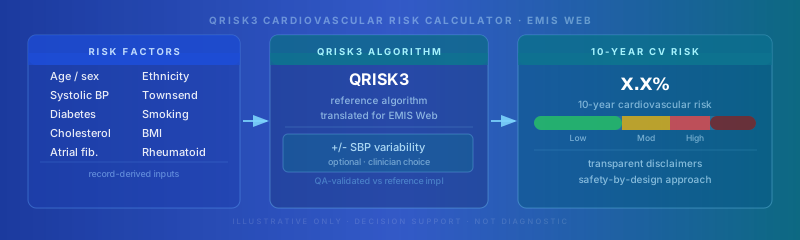
QRISK3 implemented inside EMIS Web — faster consultations, fewer transcription errors, and a validation-first approach.
QRISK3 is frequently calculated outside the clinical system, adding friction and increasing the chance of transcription errors. The workflow requires context switching between systems and manual data entry.
Approach
- EMIS Web template that calculates QRISK3 using record-derived inputs
- Explicit option to include blood pressure variability (SBP standard deviation) where appropriate
- Careful translation of the reference algorithm into platform-safe building blocks
- Repeatable QA approach comparing outputs against the official reference implementation
What this demonstrates
- Translating published clinical algorithms into production-ready tooling within real GP systems
- Safety-by-design thinking: transparency, disclaimers, and validation/traceability
- Workflow empathy: reducing clicks and context switching for time-pressured clinicians
- Pragmatic handling of missing/variable-quality data (with clear user choice and limitations)
Clinical decision supportQRISK3Risk predictionCardiovascular riskQAClinical safetyEMIS Web
Delivered with Primary Care IT Limited
Platform detail and client configuration are not disclosed.
02Free tool2026Web browser
NHS Waiting Times Explorer (RTT & DM01)
Two free public tools to explore NHS England elective and diagnostic waiting-times data. The page names the month the figures come from.
NHS England publishes RTT and DM01 waiting-times data every month as raw open datasets — but the tooling around them is limited to internal dashboards or spreadsheets. A GP wanting to compare provider waits in a two-minute conversation, or a patient making sense of their referral, has nowhere quick to look.
Approach
- RTT explorer: pick an Integrated Care Board, see waits by specialty with median, 92nd-percentile, and 18/52-week breach counts, colour-coded against the constitutional standard
- DM01 explorer: pick a hospital provider, see waits for all diagnostic modalities with 6/13/26-week breach counts, colour-coded against the operational standard
- Static files, rebuilt from each NHS England publication. The page names the month. No database.
- No login, no tracking, no analytics — the tools work as a public utility
What this demonstrates
- Turning existing open NHS datasets into usable, patient-and-clinician-facing tools without new data collection
- Static-first architecture (per-ICB JSON split, single grouped DM01 file) sized for fast page loads and simple monthly maintenance
- Accessibility-conscious UI with sortable table semantics and colour bands mapped to published NHS standards
- Deliberate scope discipline: dropped clinician-workflow features that only make sense inside a signed-in decision-support product
NHS open dataRTTDM01Waiting timesElective careDiagnosticsPublic tools
Delivered with Kairos Medical Informatics
03Free tool2025–2026Web browser
The surname alphabet is divided into proportional ranges — each patient always routes to the same person.
AaZz
Dr AdamsAa – Go7 sessions
Dr BrownGp – Ma5 sessions
Dr ChenMb – Va8 sessions
Dr PatelVb – Zz2 sessions
0%31.8%54.5%90.9%100%
- Dr AdamsAa – Go(7 sessions)
- Dr BrownGp – Ma(5 sessions)
- Dr ChenMb – Va(8 sessions)
- Dr PatelVb – Zz(2 sessions)
Band widths reflect real UK surname frequency — not equal alphabet splits
Example only — your team and ranges will differ
FairShare Workload Allocator
Fair workload allocation for practices; matching staff capacity to incoming work.
In most practices, incoming work — Pathlinks results, Docman documents, lab items — is distributed by informal rota that drifts as team composition changes. The same patient may route to different clinicians on different days, creating inconsistency and uneven workload over time.
Approach
- Surname alphabet divided into proportional bands using ONS national frequency data
- Each band maps to one team member, weighted by their session count
- Deterministic: the same patient's surname always routes to the same person
- Outputs a printable, copyable allocation table — no patient data required or stored
What this demonstrates
- Building practical tools from open statistical datasets (ONS NHS Central Register)
- Deterministic, auditable logic with explainable outputs
- Clean, print-ready outputs for immediate practice use
- Low-barrier tools can still be rigorous — no patient data, no installation required
Workload allocationPractice managementSurname distributionPrimary care admin
Delivered with Kairos Medical Informatics
04Active delivery2025–2026NHS primary care workflowsClinician-facing web platform
CASES Referrals Navigator
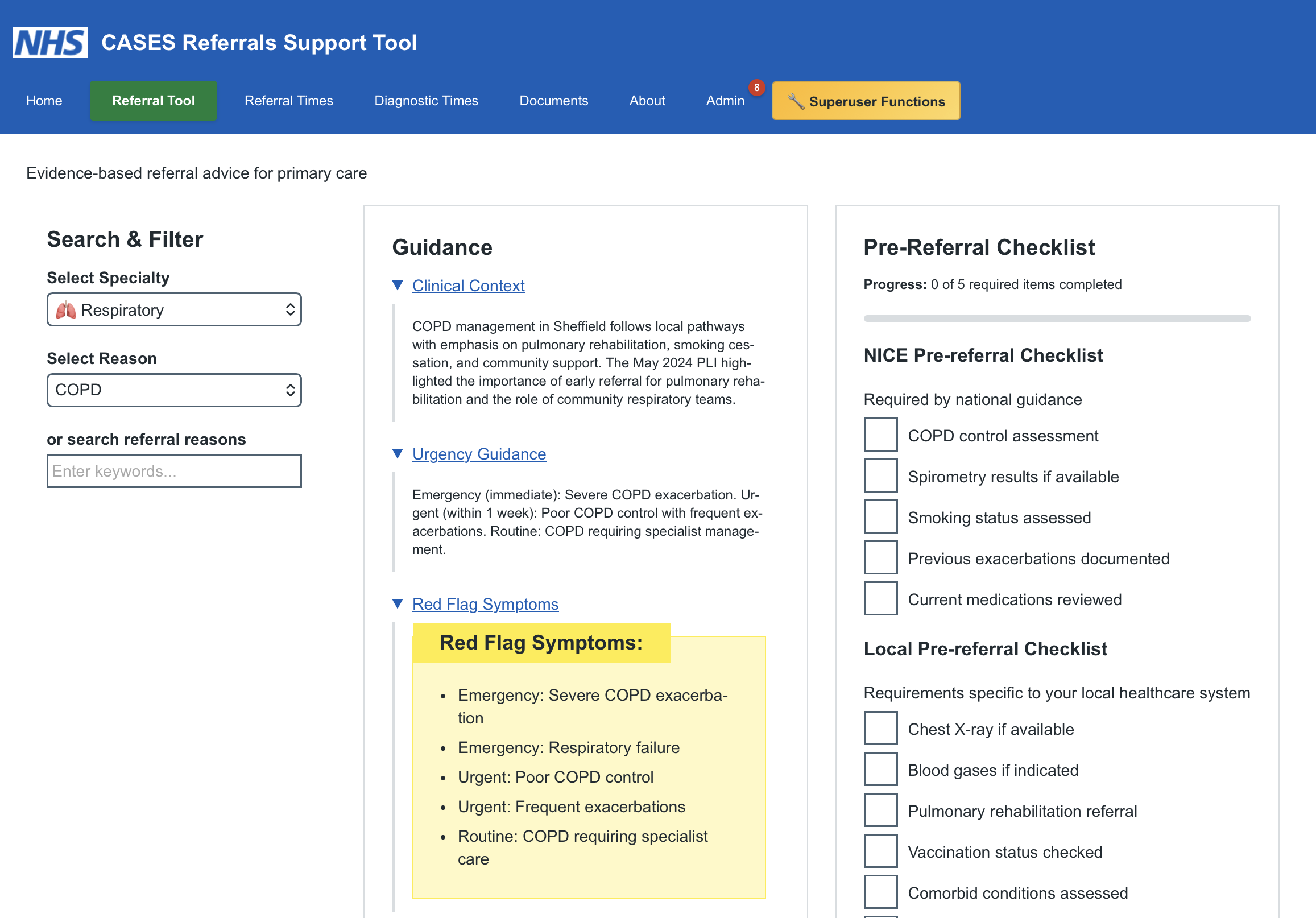
Referral decision support for primary care teams — structured prompts, clearer rationale, fewer bounced referrals.
Referral quality varies under routine workload pressure, creating avoidable rework, inconsistent rationale, and delays when pathway requirements are unclear.
Approach
- Clinician-facing referral support designed for fast in-consultation use
- Structured prompts that improve referral clarity and decision rationale
- National-and-local pathway alignment to reduce ambiguity and rework
- Governance-aware update practices to keep content reliable and accountable
What this demonstrates
- Decision support built around the patient and clinical scenario, not the other way round
- Decision support that reduces new risks
- Structured content governance to keep information reliable
- Delivery plan & design within existing NHS tooling
Clinical decision supportReferral qualityPrimary careWorkflow designClinical governance
Delivered with Kairos Medical Informatics Limited
Implementation details and client configuration are not disclosed.
05Delivered2024EMIS WebTPP SystmOne
KFRE Renal Risk Tools
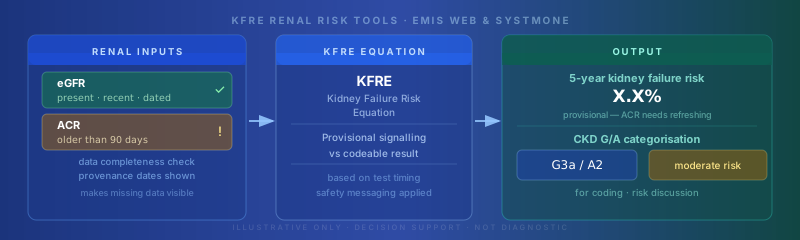
A renal risk tool that brings KFRE calculation and CKD staging into the GP consultation, without leaving the clinical system.
Renal risk stratification is often blocked by incomplete data (old/missing ACR) and workflow friction. Teams struggle to spot higher-risk patients and identify missing tests without extensive manual record searching.
Approach
- Checks whether the right renal tests are present and recent (especially eGFR and ACR) and clearly shows what's missing
- Provides a KFRE 5-year risk estimate when inputs are appropriate, with clear provenance (dates) and 'provisional vs. codeable' signalling based on test timing
- Supports quick CKD G/A categorisation from the latest results for coding and risk discussion
- Surfaces high-signal context (e.g. relevant renal history indicators, trends, and cautions) to reduce manual record searching
What this demonstrates
- Turning published clinical risk models into usable, governance-aware decision support
- Balancing usability with safety constraints in real EHR environments
- Translating guidance into prompts without creating 'alert fatigue'
- Delivered with input across clinical, pathway, and technical teams
Clinical decision supportRenalCKDKFREPrimary care EHRRisk stratification
Delivered with Primary Care IT Limited
Decision support only — not diagnostic. No patient data exported.
06Delivered2021-2025EMIS Web
Women's Health Clinical Support Pack (EMIS Web)
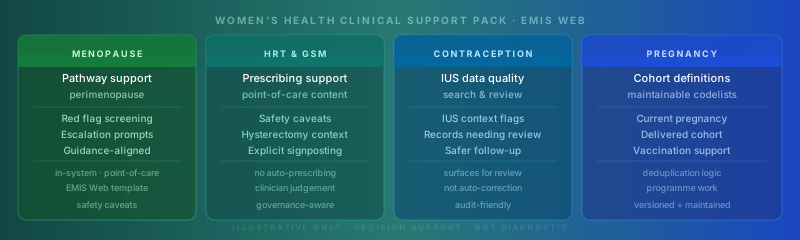
Menopause pathways, HRT and GSM prescribing support, contraception data quality, and pregnancy cohort tooling — all inside EMIS Web.
Women's health work in primary care is high volume and high impact, but guidance is content-heavy, coding is variable, and small record details (e.g. hysterectomy status, IUS context, pregnancy status) materially affect safe prescribing and reliable audits.
Approach
- Clinician-friendly menopause/perimenopause pathway representation aligned to recognised guidance, including red flags and escalation points
- HRT and GSM prescribing support content designed for point-of-care use, with explicit safety caveats and signposting
- Contraception/IUS data-quality searches to surface records needing review (not auto-correction), supporting safer follow-up and audit
- Maintainable pregnancy 'current' vs 'delivered' codelists and searches to support programme work (e.g. vaccination uptake in pregnancy)
What this demonstrates
- Turning guidance into practical in-system tools without overclaiming
- Safety-by-design: cautious language, transparent assumptions, and 'review needed' patterns
- Data quality craft: robust cohort definitions, deduplication, and audit-friendly outputs
Women's healthMenopauseHRTContraceptionData qualityClinical informaticsEMIS Web
Delivered with Primary Care IT Limited
Decision support only — not diagnostic. Follow local medicines governance.
07Delivered2021-2025EMIS WebTPP SystmOne
Anticholinergic Burden (ACB) Calculator
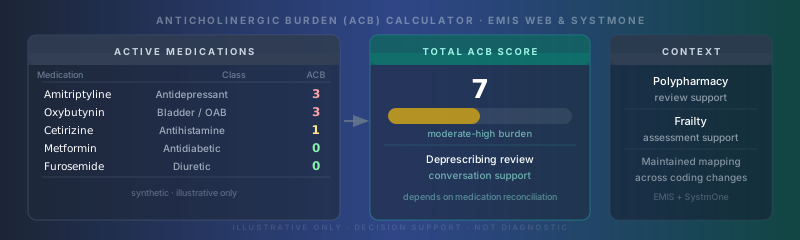
Point-of-care decision support that quantifies anticholinergic burden from active prescriptions and highlights the medications driving risk.
Quantifying cumulative anticholinergic exposure from active medications at the point of care is complex, requiring manual lookups and calculations that are time-consuming and error-prone during polypharmacy reviews.
Approach
- Translated a published clinical scale into reliable, maintainable decision-support logic inside GP clinical systems
- Instant derived ACB score with contributor breakdown to support polypharmacy and frailty reviews
- Clinician-friendly presentation (clear score + contributor breakdown) for fast use during reviews
- Clear safety messaging: calculated value depends on medication reconciliation
What this demonstrates
- Fast to use: total score on screen with a breakdown of contributing medicines
- Medication mapping kept current as codes change over time
- Supports polypharmacy review and deprescribing conversations
- Available in both EMIS Web and TPP SystmOne
Medicines optimisationPolypharmacyFrailtyClinical safetyDecision support
Delivered with Primary Care IT Limited
No external patient data storage. Implementation details are not disclosed.
08Delivered2021-2025EMIS Web
FIB-4 Liver Fibrosis Risk Calculator + Alert (EMIS Web)
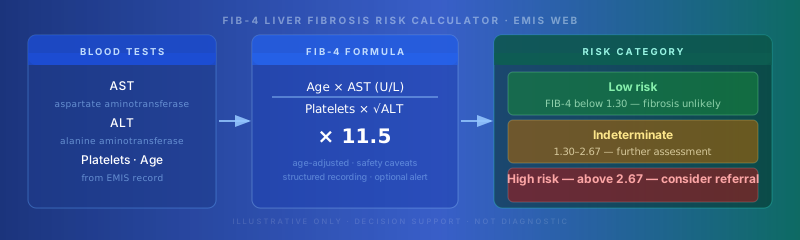
In-EMIS FIB-4 calculator + alert to surface fibrosis risk from routine bloods, safely and auditably.
FIB-4 is useful, but in day-to-day general practice it's easy for the calculation (and its caveats) to be missed, inconsistently applied, or poorly documented.
Approach
- EMIS Web calculator template that pulls/accepts AST, ALT, platelets and age, calculates FIB-4, and supports structured recording of the score
- Optional record-open alert that prompts review when configured criteria suggest possible undiagnosed fibrosis risk, including the relevant latest results and their dates
- Safety messaging for known limitations (e.g. age effects, normal transaminases, stale blood results)
What this demonstrates
- Clinical decision support design that respects real GP workflow and avoids hidden automation
- Safe, explainable rule design (clear thresholds, clear exclusions, clear caveats)
- Practical implementation in constrained clinical systems (EMIS Web), with auditability built in
Clinical decision supportEMIS WebPrimary care workflowAudit-friendly documentationLiver disease risk
Delivered with Primary Care IT Limited
Decision support only — not diagnostic. Follow local pathways.
09DeliveredMay-July 2024EMIS Web
Reasonable Adjustments Digital Flag (RADF) Toolkit
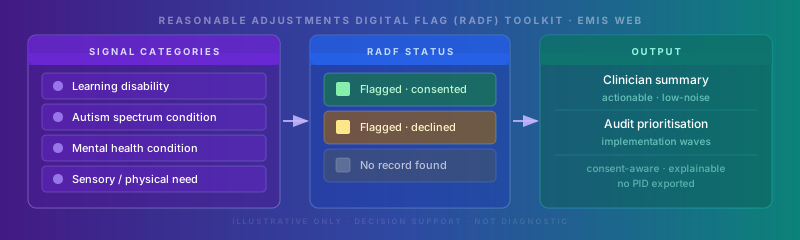
Clinical system searches and prompts that help practices record and maintain RADF information consistently, with consent-aware wording and low-noise outputs.
RADF adoption is easy to intend and hard to implement: the 'signal' that a person may need reasonable adjustments is often scattered across the record, consent status is not consistently recorded, and the clinical day leaves little time to assemble context safely.
Approach
- Structured search set for 'reasons to consider RADF', grouped by interpretable categories
- Status check pattern for RADF flag + consent/dissent (including explicit 'missing' state)
- Concise clinician-facing summary output designed to be actionable and low-noise
- Audit/prioritisation views to support implementation waves and data quality follow-up
What this demonstrates
- Translating national requirements into pragmatic GP workflows
- Building decision support that is cautious, explainable, and consent-aware
- Designing maintainable search structures that can evolve as datasets and guidance change
- Accessibility and inclusion (AIS/RADF aligned)
Clinical decision supportRADFAccessibilityInclusionData qualitySNOMEDAudit reporting
Delivered with Primary Care IT Limited
Implementation details and client configuration are not disclosed.